


The first thing to understand about your cat’s household rules is that nobody remembers agreeing to them. There was no meeting. There was no welcome pack. One day you had a perfectly ordinary chair; the next day you were asking permission to sit on its edge.
What follows is an imaginary handbook, written for fun rather than as an explanation of feline behaviour. Every cat is different. The tiny household administrator in this story is entirely fictional, even if the cardboard arrangements feel oddly familiar.
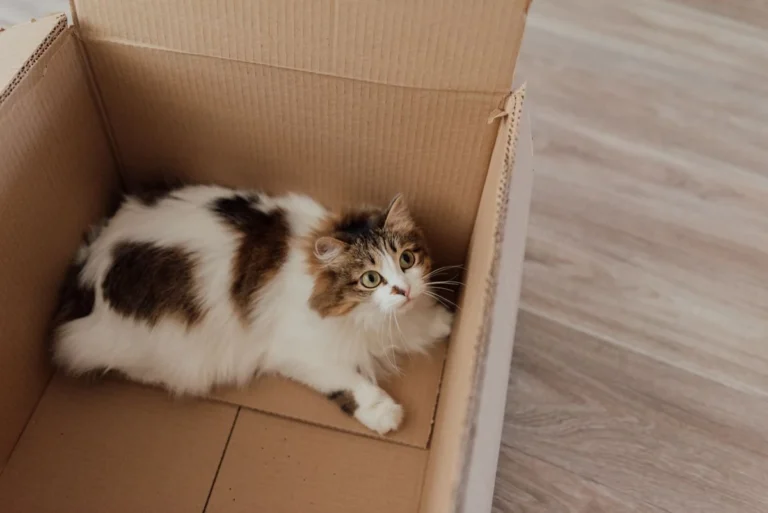
All boxes require immediate inspection
A delivery arrives. You are excited about the thing inside it. Your cat, in our fictional household, would like to know why you have filled a perfectly good property with unnecessary packaging.
The inspection begins before you have found the scissors. There is a brief walk around the perimeter, followed by a thoughtful look into the middle. If the box meets the required standard of being a box, the application is approved.
You may remove the contents. You may not remove the property. The distinction will be communicated through a look that somehow suggests you should already know better.
For the real-life version, check packaging before leaving it available. Remove tape, staples, handles, strings and loose pieces, and do not force a cat into a box for a photograph. The joke works perfectly well with the cat choosing not to participate.
The warm chair is a shared resource, mostly
You stand up to make a drink. On your return, the chair is occupied. This is not considered a takeover by the imaginary chair committee. It is a routine reassessment of the available warmth.
There are several possible solutions. You can choose another chair. You can stand beside this one and explain your original intention. Or you can sit somewhere distinctly less comfortable and announce that you preferred it anyway.
The cat will not be taking questions. The cat is currently performing the very important work of looking like a small, beautifully arranged loaf.
Every closed door needs a discussion
Our fictional cat does not necessarily wish to enter the room. That would be a narrow interpretation of the issue. The concern is that a room exists and the room has made a decision without consultation.
You open the door. The cat pauses. You wonder whether the request has been withdrawn. The cat looks down the corridor with the grave concentration of someone reviewing a very long contract.
The practical human response is less theatrical: keep boundaries that your household needs, offer appropriate spaces, and avoid turning the situation into a contest. Real cats do not need to act out our imaginary scripts.
The best photograph happens between photographs
You notice perfect light. Your cat is sitting beautifully. You reach for the camera, slowly, with the careful optimism of a person approaching a soap bubble.
By the time you open the camera, there is an ear where the face used to be. Your next frame contains half a tail. The final image is an excellent study of the place where a cat was sitting four seconds ago.
In the imaginary handbook, this is called protecting creative control. In your actual photo library, it is called having forty-three pictures of the same cushion.
Keep photo sessions brief and optional. Do not wake, restrain or repeatedly reposition a resting animal for a better shot. A peaceful, slightly imperfect photograph is a lovely result.
Ordinary company counts as an activity
Not every household rule involves a dispute. Sometimes the entire arrangement is that you read while a cat rests nearby. Nothing happens. There is no punchline, apart from the fact that you now turn pages more quietly than you did before.
That is the part a mock handbook cannot really capture. Life with an animal is made from small details: a favourite place, a familiar sound, a particular way of arriving beside you. The comedy comes from noticing those details, not from expecting every cat to behave alike.
Perhaps your cat ignores boxes, dislikes chairs and has never inspected a door. That is fine. The handbook is imaginary; their actual preferences get the final say.
A useful amendment for the human
Laugh at the invented committee, then pay attention to the real companion. Keep their spaces comfortable, respect their choices, and treat a sudden change in their usual habits as something to understand rather than a new comedy routine.
For more everyday reading, visit our cat guides. For another small break in the day, browse Funny. No chair reservation is required.